
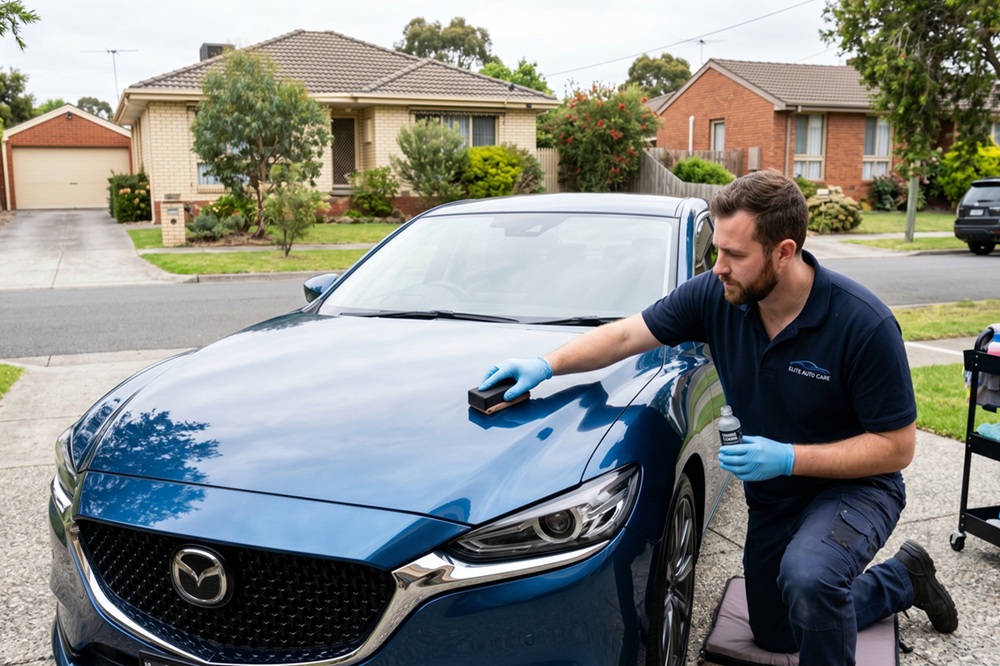
The paint on a car that lives outside doesn’t deteriorate slowly. It happens in patches, often starting on the roof and bonnet — the flat surfaces that take the most direct sun — and by the time most people notice, the damage is already past the point of a simple polish.
UV exposure is the main driver. Ultraviolet light breaks down the clear coat layer sitting on top of your paint, and once that’s compromised, oxidation sets in. The colour beneath starts to look dull, chalky, flat. On darker cars it shows up as a kind of hazy film. On reds and blues, the fade is more obvious — the colour just loses its depth. It doesn’t take years either. A single Melbourne summer, particularly in areas like Glen Waverley where the suburban heat builds up and there’s rarely much shade on a standard driveway, can do visible damage to a car that was in good condition twelve months prior.
Bird Droppings Do More Damage Than Most People Realise
A bird dropping sitting on your paint for forty-eight hours in warm weather isn’t just a cosmetic irritation. The uric acid in it is actively etching into the clear coat, and if you leave it for a week — which is easy to do if the car’s parked outside and you’re not walking past it constantly — you’re looking at marks that polish won’t fully remove.
The temperature cycle makes it worse. Paint expands slightly in the heat of the day and contracts overnight. A dropping stuck to the surface gets worked into any micro-abrasion in the clear coat as that cycle repeats. People assume a good wash will sort it out. Often it does. But not always, and the longer it sits, the worse the odds.
Tree sap does the same thing, just slower. If you’re parking under a gum tree or near any flowering tree in spring, the residue builds up without being obvious, and by the time you see it clearly you’ve already got staining.
What Happens When You Don’t Intervene Early
Dull paint that’s been left to oxidise doesn’t just look bad. It starts to lose its protective function. The clear coat is what shields the base layer from everything — water, road grime, UV, contaminants. Once it’s thinning or pitting, more damage accelerates underneath it.
A cut and polish can bring a lot of this back, depending on how far it’s gone. Cars Detailed has 22 years of this kind of work, and the difference before and after a proper machine polish on a heavily oxidised bonnet is genuinely striking. But there’s a limit. If the clear coat has worn through entirely in places, polishing doesn’t fix that — it just thins what’s left.
The smarter approach is to get ahead of it. A professional car detailing service in Glen Waverley — one that comes to you, which matters when you’ve got a full week and no time to drop a car somewhere — can assess the paint condition and treat it before the deterioration reaches that point.
Ceramic Painting as a Long-Term Answer
Ceramic painting bonds directly to the clear coat and, once cured, shrugs off most of what outdoor parking throws at a car — UV, bird droppings, water spots, the general grime that builds up on anything sitting outside in suburban Melbourne. A decent application lasts two to five years without needing to be redone. That’s not nothing when you consider how much of the damage described above happens quietly, between washes, while the car just sits there.
It’s not a substitute for detailing. The paint needs to be in the right condition before ceramic coating goes on — any surface contamination or oxidation has to be treated first, otherwise you’re sealing the problem in. But for a car that’s parked outside every day with no shelter, it’s the closest thing to a permanent fix for the weathering problem.
Honestly? The cost of ceramic coating looks a lot more reasonable once you’ve had to pay for a full paint correction you could have avoided.
A car that sits on a driveway in the eastern suburbs in summer takes a beating that most owners don’t account for. The damage accumulates quietly, season by season, and the first time you really notice it is usually when you’re about to sell.